
Representing the Patient Voice at The Future of Public Health 2026
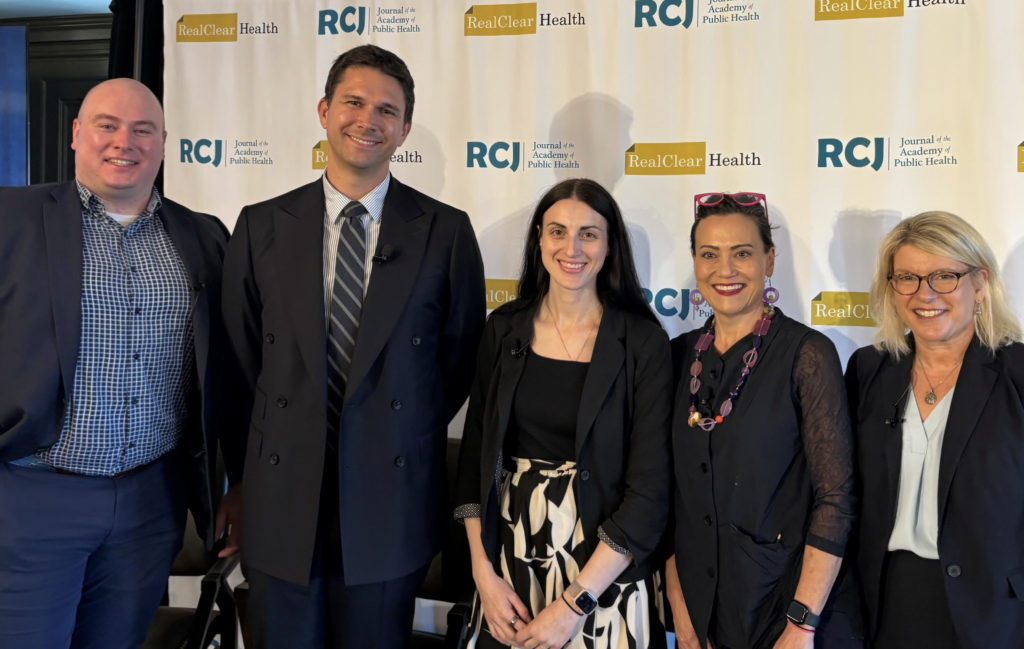
On September 9, our Executive Director, Julienne Verdi, represented the migraine and headache disorders community at The Future of Public Health 2026 in Washington, D.C. The inaugural conference, presented by the Journal of the Academy of Public Health in cooperation with RealClearHealth, brought together policymakers, clinicians, researchers, patient advocates, and healthcare industry leaders for conversations about trust, cost, risk, access, and innovation in American healthcare.
The program included keynote addresses from National Institutes of Health Director Dr. Jay Bhattacharya and Dr. Sandro Galea, Dean of the School of Public Health at Washington University in St. Louis. Former Centers for Disease Control and Prevention Director Dr. Robert Redfield and other national leaders also participated in discussions about prescription drug policy, healthcare costs, biosecurity, vaccines, hospitals, insurance, and prior authorization.
Julienne joined James Stursberg of the U.S. Department of Health and Human Services, Jackson Hammond of the Paragon Health Institute, and Michele Oshman of the Biotechnology Innovation Organization for the conference’s prior authorization panel. The discussion was moderated by Sue Peschin, President and CEO of the Alliance for Aging Research.
With government, policy, industry, and patient advocacy represented on the panel, Julienne’s role was to make sure the discussion remained connected to how prior authorization is actually experienced by patients and families. A full recording of the panel can be found at the end of this post!
A delay is not neutral
Prior authorization is often evaluated through administrative measures such as approval times, denial rates, appeals, and overall spending. Those measures may tell us something about how the process operates, but they do not tell us what happens to a patient while the process is underway.
As someone who lives with migraine and is also the parent of a child with migraine, Julienne spoke about the consequences that are difficult to capture in an insurer’s data. A delay can mean additional days or weeks in pain, missed work or school, an avoidable visit to the emergency department, or a person’s attacks becoming more frequent and disabling while they wait.
For people with migraine and headache disorders, these consequences can be especially serious. Migraine is the leading cause of years lived with disability among young women globally and is associated with increased suicidal ideation and attempts. For some people with cluster headache, suicidal risk can be particularly acute during attacks. Prior authorization does not create all of these risks, but it can leave someone without the treatment their clinician believes may help during a period of severe pain, disability, or crisis.
Julienne also spoke about the frustration of waiting months to see a headache specialist, finally leaving that appointment with a treatment plan, and then learning at the pharmacy that the treatment has not been approved or will only be covered after trying and failing older medications. At that point, the patient may have to wait even longer, seek care in an emergency department, or rely on an already stretched clinical team to complete additional paperwork and pursue an appeal.
These delays create costs throughout the healthcare system. Clinicians and staff spend hours responding to insurance requirements instead of caring for patients. Parents and caregivers miss work. Employers lose productivity. Families take on additional expenses, and emergency departments see patients who may have been better served by receiving appropriate treatment earlier. What appears to be a savings for an insurer may simply move those costs somewhere else.
Measuring the outcomes that matter to patients
The panel also discussed whether the healthcare system is measuring the right outcomes when it evaluates prior authorization. Knowing how many requests were approved or how quickly a decision was issued is not enough if we do not also ask what the delay meant for the patient.
For families living with migraine and headache disorders, disease burden is not measured only in headache days. It is also measured in the parts of life people miss: the school concert a child rehearsed for, a birthday spent in a dark room, a family gathering interrupted by an attack, or another day when a parent could not work or care for their children as planned.
We should be measuring whether patients can attend school, work, care for their families, and participate in their lives. We should also examine caregiver burden, lost income, out-of-pocket costs, worsening symptoms, emergency visits, hospitalizations, and treatment abandonment.
Treatment abandonment deserves particular attention. When a patient does not appeal a denial, it does not necessarily mean the denial was appropriate or that the patient agreed with it. The person may have been too sick or overwhelmed to continue, unable to afford the treatment while waiting, or unsure how to navigate the appeals process. In some cases, the process itself becomes the reason the patient never receives care.
An eventual approval should not automatically be counted as a successful outcome. If the patient’s health deteriorated or they lost weeks of work, school, and family life while waiting, the final approval does not erase that harm.
What successful reform should look like
The conference was focused not only on the problems facing public health today, but also on where the healthcare system should be heading. For prior authorization and step therapy, we believe the goal should be more ambitious than making the existing process move a little faster.
On the panel, Julienne argued that gold-carding is not the solution. While allowing certain clinicians to bypass prior authorization may reduce paperwork for some patients, it risks creating a two-tier system. A patient who has access to a gold-carded clinician may receive treatment without delay, while another person with the same condition and the same medical need must still wait for approval because their clinician does not have that status.
This is particularly concerning for people who already have difficulty accessing headache specialists, including patients in rural and underserved communities. Access to appropriate treatment should not depend on where someone lives, which clinicians accept their insurance, or whether their clinician has been granted special status by a health plan.
Instead, successful reform should begin with passing the Safe Step Act, H.R. 5509 and S. 2903. The legislation would create a clear and timely exception process for people covered by employer-sponsored health plans who are subject to step therapy. It would protect patients when a required treatment has already failed, is expected to be ineffective, is contraindicated or likely to cause harm, or would interfere with the person’s ability to work or perform daily activities. It would also protect patients who are already stable on an effective treatment.
We also need health plan formularies and coverage policies to keep pace with current clinical guidelines and recommendations. When a treatment is recommended as a first-line option, patients should not be required to fail older treatments before they can access it. A clinician following current standards of care should not have to seek an insurer’s permission each time they recommend an appropriate first-line treatment.
At the same time, aligning coverage with clinical guidelines cannot mean replacing one rigid set of insurance rules with another. Guidelines are an important starting point, but patients are not interchangeable. Clinicians must still be able to consider each person’s medical history, other health conditions, previous treatment experiences, potential side effects, daily responsibilities, and preferences. There must be a clear and timely pathway to individualized care when the standard first-line option is not appropriate for a particular patient.
For us, successful reform means passing the Safe Step Act, ending unnecessary prior authorization for recommended first-line treatments, and protecting the ability of patients and clinicians to make individualized treatment decisions. The goal is not to create a faster or more selective permission process. It is to make sure that when a patient and clinician develop an evidence-based treatment plan, the patient can access it without an unnecessary delay.
We appreciated the opportunity to bring the experiences of people living with migraine and headache disorders into The Future of Public Health 2026. These diseases, and the barriers patients face in accessing treatment, belong in broader conversations about public health, healthcare spending, and clinical care. We are grateful to the Journal of the Academy of Public Health and RealClearHealth for inviting us to be part of this important conversation and for making space for the patient voice in discussions about the future of healthcare.